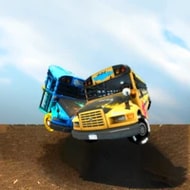
What happens when your bus flips onto its roof mid-derby, wheels spinning uselessly while a rival bus lines up for the finishing hit? That’s the exact moment School Bus Demolition Derby stops being a driving game and turns into a scramble to survive the next ten seconds, and it’s a scenario most regular players have lived through more than once.
| Genre |
3D destruction derby and arena racing |
| Vehicles |
Multiple school buses, each with distinct stats |
| Events |
Racing tracks and survival derby arenas |
| Core Goal |
Be the last bus still standing or place well in a race |
Picking a Bus Before the First Match
School Bus Demolition Derby gives you a handful of buses to choose from before you ever enter an arena, and each one leans differently toward speed, armor, or handling. A heavier bus survives head-on collisions better but turns slower on the dirt ovals, while a lighter one darts around the arena but crumples faster under repeated hits.
New players often default to whichever bus looks the most aggressive, then wonder why they’re losing races on the tighter oval tracks. Matching your bus to the event type matters more than raw stats on a menu screen, and it’s one of the first lessons the game teaches without actually saying so.
Unlocking additional buses comes from earning currency through races and derby wins rather than any separate progression system. Players asking how to unlock more buses in School Bus Demolition Derby are really asking how to grind efficiently, and the honest answer is that survival derby events tend to pay out faster than straight races once you’ve got a bus that can take a hit.
Repainting a bus doesn’t change its stats, but plenty of players do it anyway. It’s a small cosmetic touch that has nothing to do with performance and everything to do with making your bus recognizable in a crowded arena.
Arenas, Dirt Ovals, and Survival Derby Events
The game splits its roughly 29 levels between two very different formats: races on dirt ovals and speedway-style tracks, and pure survival derby matches in round arenas. They reward almost opposite skill sets, which is part of why the community stays split on which mode is actually more fun.
Dirt oval races are about smooth, controlled steering rather than chaos. Overcorrecting on a turn costs more time than a rival bumping you does, and players coming in expecting nonstop crashing tend to find these events frustratingly technical at first.
Survival derby arenas flip that entirely. Here the goal is straightforward destruction, staying mobile enough to avoid getting boxed in while looking for openings to ram rivals into the arena’s edges. Early in the game these matches feel chaotic and a little random, but by the time you’ve run a dozen of them, reading opponent positioning becomes second nature.
Some players stick almost entirely to one mode or the other, and the game doesn’t punish that specialization. Day and night event variants add a further layer, since visibility during night races changes how confidently you can commit to aggressive lines.
Armor, Nitro, and the Upgrade Path in School Bus Demolition Derby
Currency earned from wrecking rivals and finishing races feeds directly into upgrades: engine power, body armor, tire grip, and nitro capacity. There’s no single correct order to buy these in, but most experienced players prioritize armor first, since a bus that survives longer earns more currency per match regardless of mode.
Nitro deserves special attention because it’s the one upgrade that has to be triggered manually rather than applying automatically like most boosters. Holding it for the wrong moment wastes a genuine advantage, while using it right before a ram turns a glancing hit into a match-ending collision.
Boosters selected before a match, including armor, extra damage, and tire protection, apply automatically once the event starts, which means the real decision happens in the pre-match menu rather than mid-race. Players asking about the best upgrades to prioritize in School Bus Demolition Derby usually get better mileage from balancing armor and tire grip early, then chasing engine power once survival stops being the main bottleneck.
Overspending currency on engine upgrades before armor is a common early mistake, since a fast bus that dies in two hits doesn’t get to use its speed for long.
Ramming Technique and Damage Deformation
The physics engine tracks real-time damage deformation, meaning a bus that’s taken a beating visibly shows it, and that visual feedback doubles as useful information mid-match. A rival with a crumpled front end is more vulnerable to a follow-up hit than their health bar alone might suggest.
- Aim for the sides of a rival bus rather than head-on, since side impacts deal more damage while risking less to your own front end
- Watch for opponents lining up a straight run at you, since a well-timed swerve can bait them into missing entirely
- Target buses that are already visibly damaged, since a second hit in the same spot tends to finish them faster
Head-on collisions punish both sides roughly equally, which sounds fair until you remember that a rival’s bus might simply be tankier than yours. Trading hits evenly with a heavily armored opponent is a losing strategy over a full match, even if any single collision looks like a draw.
Rollovers are the derby’s most dramatic failure state. A poorly angled hit, especially at speed, can flip a bus onto its roof, leaving it defenseless until it can right itself. Players who understand this tend to hold back on aggressive rams against faster, lighter buses that are more prone to tipping.
What School Bus Demolition Derby Doesn’t Reward
Pure aggression stops working past the early levels. Players who charge every opponent head-on tend to plateau quickly, since a badly damaged bus earns less currency at the end of a match even if it technically survives.
The game also doesn’t reward memorizing a single winning strategy across every arena. Round arenas, dirt ovals, and speedway tracks all favor different approaches, and players who try to force one playstyle everywhere tend to underperform compared to those who adjust bus choice and driving style per event.
What keeps School Bus Demolition Derby from feeling repetitive is exactly that variation. A run built around outlasting rivals in a tight arena feels nothing like a clean lap on a dirt oval, even though both use the same core bus and the same upgrade system underneath.
School Bus Demolition Derby never pretends to be more than what it is, a bright, destructive arcade game where a well-placed ram against a rival’s side panel feels as satisfying on the hundredth match as it did on the first, and getting there with a fully armored, nitro-ready bus is most of the fun along the way.