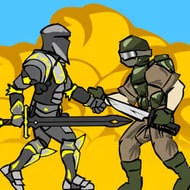
Age of War looks like a simple stick-figure war game you could finish on autopilot, but it plays like a constant negotiation between spending money now and holding it back for something bigger.
| Genre |
Side-scrolling base defense strategy |
| Eras |
5 (Stone, Medieval, Renaissance, Modern, Future) |
| Units |
16 total across all eras |
| Turrets |
15 total across all eras |
| Win condition |
Destroy the enemy base |
The Core Loop Behind Age of War
Two bases face off across a single lane, and everything you do funnels into one decision made over and over: spend gold on units, spend it on turrets, or hold it back for the next evolution. Age of War never adds a second lane or a hidden resource to complicate that choice, it just keeps raising the stakes on the same three options as the eras roll forward.
What makes that loop hold up over a full match is timing. Units earn gold and experience when they land kills, gold buys more units and turrets immediately, while experience slowly fills a separate bar that triggers your next evolution once it’s full. Spend everything on units and your evolution bar creeps along slower than your opponent’s. Hold back too much and your lane collapses before you ever reach the next era’s stronger roster.
Newer players tend to spend every coin the instant it appears, sending unit after unit down the lane without pausing to build a turret. That approach works early in the Stone Age when both sides are equally weak, but it stops working the moment the opponent evolves first and suddenly has units your current roster can’t answer.
Starting the Stone Age Without Wasting Gold
You begin with club-wielding cavemen and dinosaur riders, cheap units that die fast but cost almost nothing to send. The temptation is to spam them in a constant stream, and while that can pressure a passive opponent, it also means you’re spending gold on units that contribute nothing to your evolution timer once they’re dead.
A steadier opening puts a turret down early, even a basic one, because a turret keeps dealing damage for the rest of the match without needing to be repurchased. That single structure often does more long-term work than three or four Stone Age units combined, and it frees up gold on later turns for evolution instead of constant unit replacement.
Medieval Age and the First Real Turning Point
Once you evolve, Swordsmen, Archers, and eventually Knights replace the Stone Age roster entirely, and your base gets a visible upgrade alongside stronger turret options like the catapult. This is the point in a match where the gap between an aggressive opener and a defensive opener starts to show clearly.
Players who leaned defensive in the Stone Age usually walk into Medieval Age with more gold banked and a cleaner path to their next evolution, since they weren’t burning coin on units that died without building toward anything. Players who spammed early often find themselves stuck fielding weaker Stone Age leftovers a beat longer than they’d like, right as the opponent’s Medieval units start pushing down the lane.
Each era also comes with its own special attack, and Medieval Age’s version hits both air and ground targets, which matters later since most specials past this point only hit ground units. Saving that special for a moment when several enemy units cluster in front of your base gets far more value than triggering it on a single weak unit early.
Renaissance Age Pressure and Overextension
By the time you reach Renaissance Age, unit costs climb noticeably and turret damage scales up to match. This is usually where matches start feeling less forgiving, because a single overextended push that gets wiped out can set your economy back for several turns while the opponent keeps advancing.
The most common failure point here is treating evolution like an automatic reward instead of a decision. Evolving the instant your bar fills, without a defensive turret in place first, leaves your base exposed for exactly the window your opponent needs to punish you. A good rule players settle into by this stage is holding the evolution for a turn or two if your lane defense isn’t ready, even though the instinct is always to jump to the next era as fast as possible.
- Keep at least one strong turret active before triggering evolution, not just after
- Watch your opponent’s unit roster to judge which era they’re likely already in
- Don’t let banked gold sit idle once you’re close to affording a key turret upgrade
Modern Age Tanks and Turret Trade-Offs
Modern Age brings Infantry, Melee Infantry, and Tanks into the mix, alongside turret options like the Rocket Launcher and Double Turret. Tanks in particular change how a lane plays out, since they soak up far more damage than anything from earlier eras and can walk through a turret line that would have stopped a Medieval push cold.
Players who favor a defensive style tend to lean hard on the Double Turret here, since stacking damage output on a single structure often outpaces trying to match Tank spam with cheaper Modern Age infantry. Meanwhile, aggressive players who like keeping constant pressure on the enemy base often prefer cycling Infantry rapidly, betting that consistent chip damage forces the opponent to react rather than build up a clean defense.
This is also where Age of War’s special attacks become genuinely decisive rather than just a nice bonus. A well-timed special that catches a cluster of Tanks before they reach your base can undo several turns of enemy investment in a single moment, which is part of why timing the special instead of using it reactively separates stronger players from newer ones.
Future Age and the Endgame Grind
Future Age is the final evolution, unlocking the strongest units and turrets in the game alongside a base that looks nothing like where you started. Matches that reach this point tend to slow down considerably, since both sides usually have strong enough defenses that a single push rarely ends things outright.
Once both players are sitting in Future Age, the game shifts almost entirely toward turret positioning and special attack timing rather than raw unit spam. It’s a noticeably different rhythm than the early Stone Age scramble, and some players find this stretch of a match drags compared to the faster pace of the earlier eras, which is a fair criticism the community brings up fairly often when comparing Age of War to its sequels.
Balancing Offense, Defense, and Evolution Speed
There’s no single winning formula in Age of War, and that’s part of why matches against different opponents feel distinct even though the core systems never change. An overly aggressive player burns through gold and falls behind on evolution, while an overly defensive player can let the opponent reach a stronger era first and simply overpower a well-built defense with numbers.
Support-minded players who enjoy managing several systems at once tend to gravitate toward balancing turret upkeep, unit spending, and evolution timing all in the same turn, treating the whole match as one continuous resource puzzle rather than a series of individual pushes. Understanding how many kills you typically need before your evolution bar fills, and building your spending around that rhythm rather than reacting turn to turn, is usually what separates a controlled game from a chaotic one.
Players sometimes ask whether it’s better to evolve the instant the bar fills or wait for a safer window, and the honest answer depends on what your lane looks like at that exact moment. If your defense can hold for another turn, waiting almost always pays off, since evolving into an exposed base is one of the most common ways matches get lost even by players who were ahead moments earlier. Others ask why their units seem to die instantly against Tanks once Modern Age arrives, and that comes down to raw unit health scaling, which is exactly why leaning on turret damage rather than pure unit numbers becomes necessary once Tanks show up. A third common question is whether spamming the cheapest unit available is ever a good strategy, and while it can pressure a passive opponent early in the Stone Age, it stops paying off once turret defenses on the other side start scaling past what cheap units can punch through.
Age of War rewards the kind of player who treats gold, experience, and turret placement as one connected system instead of three separate tasks, and whether you’re grinding through the Stone Age’s dinosaur riders or holding a Double Turret line against a wave of Modern Age Tanks, the game is still asking the same question it asked in the first ten seconds: spend now, or wait for something stronger.