Dungeon Clawler looks like a novelty arcade toy bolted onto a roguelike, but it plays like a deckbuilder that punishes anyone who treats the claw as a gimmick instead of the entire combat system.
Replacing a Paw With a Claw
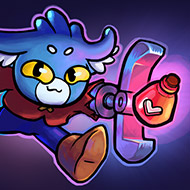
The premise is short and a little absurd: the dungeon lord chops off your rabbit paw to use as a lucky charm at the gambling table, and you replace it with a mechanical claw before descending into the dungeon to take it back. Every fight in Dungeon Clawler runs through that claw, which is dropped into a machine full of weapons, shields, and trinkets you’ve collected on the run so far.
Instead of drawing a hand of cards, you’re grabbing physical items out of a bin, and what actually lands in the scoring slot is what you get to use that turn.
How Combat Actually Works Turn to Turn
Each turn drops your current item pool into the claw machine, and you get a limited, real-time window to grab as much as you can before the turn ends. What you successfully pull determines your attack, your block, or whatever support effect that item provides. Miss the grab, or watch an item bounce out of the collection slot at the last second, and that turn’s plan falls apart no matter how good your build looked on paper.
It’s genuinely tense in a way card-based deckbuilders rarely manage, because the randomness in Dungeon Clawler isn’t just about what you draw, it’s about whether your hands are actually good enough to catch it.
Why Item Size and Material Change Everything
Not every item behaves the same way inside the machine. Larger weapons give the claw more surface area to grip, making them easier to grab consistently, while smaller items like paperclips or shivs are quick to pick up but slip out just as easily. Material matters too, unlocking specific synergies with certain claw types and perks once you start building around a theme rather than grabbing whatever’s closest.
A wand added to your pool lets you heal directly, while a water bottle fills the machine itself, making every item inside it easier to catch for the rest of the fight. Builds that lean into synergy players who chase these interactions tend to get far more mileage out of Dungeon Clawler than players who just grab the nearest heavy item every turn.
The Physics Problem Players Keep Bringing Up
The most consistent complaint around Dungeon Clawler isn’t the concept, it’s the execution of the claw itself. Items can get wedged in corners, knocked around by other objects mid-grab, or dropped at the exact wrong angle right before reaching the collection slot, which means the one item you actually needed can bounce back into the pile after a clean grab. It’s a real frustration players openly discuss, and it doesn’t fully go away even once you unlock the magnetic and tentacle claw variants meant to soften it.
That physics unpredictability is also part of the appeal for a lot of the community, since a perfect grab under pressure feels earned in a way a guaranteed card draw never quite does.
Difficulty Modes and What Endless Mode Changes
Dungeon Clawler offers four difficulty settings, Normal, Hard, Harder, and Nightmare, letting you scale the challenge well beyond a first clear. Beating the dungeon boss doesn’t actually end a run either, since Endless mode keeps the descent going indefinitely for players who want to see how deep they can push a single build before the claw finally fails them.
Strategy-minded players tend to gravitate toward Nightmare runs specifically to test how far a synergy build can be pushed before item variety runs out, while players who just want a longer casual session tend to stick with Endless mode on the lower difficulties.
Characters and Playstyles Worth Trying
Multiple playable heroes are available, each built around distinct abilities and item preferences, and part of Dungeon Clawler’s replay value comes from how differently the same claw machine plays depending on who’s operating it. A fire-focused character, for instance, plays noticeably differently from one leaning on poison stacking, and community discussion around which elemental approach is currently weaker is one of the more active ongoing debates.
That’s a fair criticism worth naming directly: some elemental kits in Dungeon Clawler are more consistently praised than others, and fire in particular gets singled out by players as needing stronger perk support to compete with poison’s stacking potential.
Dungeon Clawler earns its concept by refusing to let the claw machine be a joke bolted onto a normal roguelike, and once you’ve fumbled a grab on Nightmare difficulty with the dungeon lord’s stolen paw on the line, that mechanical claw stops feeling gimmicky and starts feeling like the whole game.